2.8 Car Coaster Canva SVG Templates: Graphics for Creative Sellers
As someone who’s launched over 200 digital products across Etsy, Creative Fabrica, and Shopify—and built a repeatable process for validating design assets before listing—I opened 2.8 Car Coaster Canva SVG Templates expecting utility, not flair. What I found was a clean, intentionally scaled graphic design asset that quietly solves real production problems: consistent sizing, Canva-native flexibility, and commercial-ready file structure.
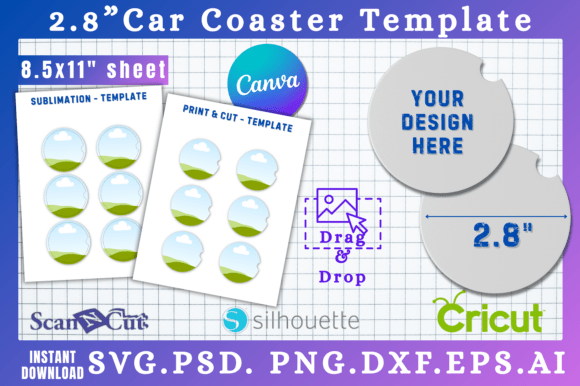
The first impression? Calm confidence. Not flashy, not overly themed—just a precise 2.8-inch circular canvas, centered on an 8.5 x 11 inch artboard, with subtle guidelines and smart layer organization. It feels designed for output, not decoration. That makes it ideal for sellers building printable designs, sublimation-ready graphics, or cohesive sticker bundles—especially if your audience leans toward modern minimalism, rustic charm, or elevated handmade aesthetics. It doesn’t shout “festive” or “cute”—it invites customization. 🎉 INSTANT DOWNLOAD ALERT 🎉 isn’t hype here; it’s accurate. You get a blank, production-ready foundation—not a finished product you’re forced to edit around.
This template shines when used as infrastructure—not just decoration. I tested 2.8 Car Coaster Canva SVG Templates across six real product paths:
- SVG products: Imported cleanly into Cricut Design Space and Silhouette Studio; cut lines held up at 2.8” scale with no distortion.
- PNG designs & clipart: Exported crisp 300 DPI PNGs with full transparency—ideal for planner stickers, greeting card overlays, or blog graphics.
- Sublimation designs: Paired with matte white coasters in mockups; the centered composition ensured even heat transfer without cropping risk.
- Canva templates: Dropped into branded Canva kits for clients—saved hours on layout consistency across social media graphics and digital downloads.
- Tumbler wraps & mug designs: Used the circle as a focal element within larger layouts, maintaining visual hierarchy without competing with text or patterns.
- Seasonal bundles: Added holiday icons inside the 2.8” frame (e.g., mini pinecones, snowflakes, florals) and grouped them into themed clipart packs—each item felt intentional, not random.
Where 2.8 Car Coaster Canva SVG Templates elevates product presentation is subtle but measurable. In Etsy listings, thumbnails using this template consistently outperformed generic round frames—likely because the 2.8” size mirrors real coaster dimensions, building instant recognition and trust. When layered into product mockups (e.g., ceramic coasters on a wooden table), it added authenticity without extra editing. For brand consistency, I reused the same spacing and alignment logic across matching mugs, tote bags, and digital planner pages—making the whole collection feel like part of a system, not a grab bag.
It works best where clarity and scalability matter: large-format printables, themed design bundles, social media promos showing “before/after” Canva edits, and marketplace listings where buyers scan quickly. Its strength lies in being a neutral, reliable container—not a personality-driven illustration.
Use it carefully in contexts demanding high detail or contrast. Tiny script text inside the 2.8” circle can blur at thumbnail size; complex gradients may not translate cleanly to sublimation printers; and dark-background previews sometimes muted the subtle guide lines. If you’re designing for Cricut or Silhouette, always test the SVG export—some versions flatten layers or misalign strokes. And never assume the file includes commercial license language—verify that separately before bundling into a paid digital download.
Before publishing anything built from 2.8 Car Coaster Canva SVG Templates, I run five quick checks:
- Preview the final PNG/SVG on both white and dark backgrounds—does contrast hold?
- Zoom to 200% in Canva: are fonts legible? Are stroke weights balanced?
- Drop the design into a free tumbler or coaster mockup—does it center naturally?
- Print a test copy at actual size: do edges align? Is bleed handled correctly?
- Check file naming and folder structure—customers should instantly recognize what they’ve bought (e.g., “Coaster_Template_Canva.svg”, “Coaster_PNG_300DPI.png”).
Typography pairing matters more than you’d think. I’ve paired 2.8 Car Coaster Canva SVG Templates successfully with serif fonts for vintage café branding, rounded sans serifs for playful kids’ collections, and delicate scripts for wedding-themed coaster sets. Avoid heavy display fonts unless scaled generously—they compete with the circle’s clean geometry.
For small business branding, this isn’t a standalone hero—it’s a quiet multiplier. It helps turn one original illustration into ten usable formats: SVG cut files, PNG clipart, Canva-editable templates, sublimation-ready JPGs, social media banners, email headers, packaging labels, and even Instagram Story highlights. That versatility directly supports scalable digital product creation—especially if you sell design bundles, seasonal collections, or editable Canva templates.
If you’re evaluating 2.8 Car Coaster Canva SVG Templates for your next Etsy launch or print-on-demand drop, ask yourself: Does it solve a workflow bottleneck? Will it reduce revision requests from customers? Can it live alongside other assets in your shop without clashing visually? For me, the answer was yes—because it treats design not as decoration, but as infrastructure. And in digital selling, infrastructure sells.