Tic Tac Label Canva Template
First Impressions: Sweet, Compact, and Surprisingly Versatile
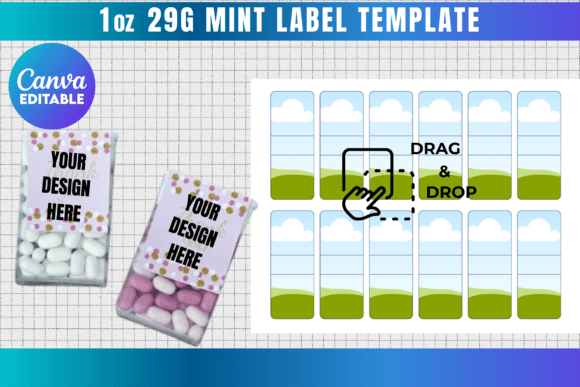
When I opened the Tic Tac Label Canva Template for the first time, I wasn’t expecting much beyond a cute party favor wrapper—but what stood out immediately was its intentional minimalism. The layout is clean and centered, built around that familiar 1oz / 29g rectangular shape, with soft mint tones, subtle rounded corners, and just enough visual breathing room. It doesn’t scream “embroidery,” but it *whispers* “handmade charm.” As a designer who regularly translates digital graphics into stitched reality, I appreciated how the template’s proportions naturally suggest a small-scale embroidered patch or label—not oversized appliqué, but something you’d stitch onto a baby onesie cuff, a linen tea towel hem, or the front pocket of a custom tote bag.
A Real Project Moment: Stitching It Onto a Linen Apron
Last week, I used the Tic Tac Label Canva Template to create a branded label for a small-batch linen apron line—think boutique kitchen goods for Etsy sellers and local craft fairs. I edited the text in Canva to read “Baked With Love • Est. 2024,” resized it slightly to fit a 3” x 1.5” hoop, and exported it as a high-res PNG for digitizing. What made this work wasn’t just aesthetics—it was how the template’s balanced negative space translated into clean satin-stitch borders and legible fill-stitch lettering at under 2 inches wide. No crowding. No lost detail. Customers noticed it instantly: “Is that a real mint box? So clever!” That kind of quiet recognition—where design feels both personal and polished—is rare in tiny embroidery labels.
Where It Shines (and Where It Needs Care)
The Tic Tac Label Canva Template excels in lightweight, structured applications: embroidered patches, pillow cover tags, baby blanket corner labels, holiday gift tags, and personalized sweatshirt hems. Its modest scale and clear hierarchy make it ideal for machine embroidery design on stable fabrics like cotton poplin, twill, or medium-weight linen. On a structured tote bag or apron, it reads beautifully—even at 1.75” tall—because the layout avoids thin lines, fine serifs, or overlapping elements that blur when stitched.
But here’s where attention matters: avoid using it directly on stretchy knits (like t-shirt fabric) without proper cutaway stabilizer and reduced stitch density. Tiny lettering can vanish on dark fabric unless you boost thread contrast—test it in black-and-white mockups first. And while it’s perfect for flat surfaces, skip curved areas like cap fronts unless you’re willing to re-digitize for distortion compensation. Also, don’t assume the mint color palette translates cleanly to thread—swap to ecru, sage, or charcoal depending on your base fabric. This isn’t a one-size-fits-all embroidery file; it’s a starting point that rewards thoughtful adaptation.
What It Adds to Your Finished Product
Used well, the Tic Tac Label Canva Template elevates perceived value—not through flash, but through intention. A handmade product with a tidy, consistent label signals care. For Etsy sellers, it reinforces brand cohesion across listings (pair it with matching printable mockups). For craft fair vendors, it adds that “designed, not slapped-on” polish customers associate with professional small shop products. I’ve watched buyers pause longer over items with this kind of labeling—they touch the stitching, tilt the item to see the texture, even ask about the story behind the mint motif. That engagement? It starts with smart, scalable design assets.
Practical Notes Every Embroidery Designer Should Keep Handy
- Always test first: Stitch the Tic Tac Label Canva Template on scrap fabric matching your final project’s weight and weave—especially if using textured or dark fabric.
- Check thread color contrast: Mint ink on screen ≠ mint thread on navy linen. Print a grayscale version to preview readability.
- Review stitch density: If digitizing yourself, keep fill-stitch areas open enough to avoid puckering on lightweight cotton or baby clothes.
- Confirm hoop size compatibility: The template fits comfortably in 4” hoops, but push beyond 3.5” only if your design software allows clean scaling without pixelation.
- Inspect small details: Rounded corners and subtle shadows look lovely on screen—but they’ll disappear in satin stitch. Simplify or remove non-essential graphic elements before digitizing.
- Use proper stabilizer: Tear-away works for stable fabrics; cutaway is safer for stretchy or delicate materials like baby embroidery or holiday embroidery on velvet.
- Verify licensing: Since this is a Canva-based Graphics asset, confirm whether your Canva plan permits commercial use of edited templates—especially if selling finished embroidered items or digital embroidery files.
Final Thought: A Quiet Workhorse, Not a Showstopper
The Tic Tac Label Canva Template won’t replace your go-to monogram or bold logo—but it fills a very real gap: the need for a charming, adaptable, small-format label that feels handmade without demanding advanced digitizing skills. It’s the kind of digital embroidery file that supports your craft business quietly: helping you ship consistent, gift-ready items; reinforcing your brand voice across embroidered patches, custom apparel, and nursery decor; and giving customers a tactile reason to remember your name. For embroidery designers, Etsy sellers, and creative entrepreneurs who value clarity over clutter, it’s less of a “template” and more of a thoughtful design partner—one that knows exactly when to step forward, and when to stay perfectly, politely, in the corner.